
Passive Income Isn't Passive, and It Won't Make Your Grandchildren Rich by Itself
Passive income isn't passive, and inflation eats most of it. Here's the real math for Bangladesh, and what actually passes wealth to the next generation.

Picture a man in his fifties who has spent twenty years working for other people. He saves hard, buys a flat in a decent neighborhood, and rents it out. At every family gathering he describes the rent as free money. For the first two years, it nearly is.
Then the tenant leaves and the flat sits empty for three months. The building’s service charge goes up. A pipe bursts in the wall, and the repair costs more than the last two months of rent combined. His new tenant pays late, then later. By year five, he’s spending more hours on the flat than some people spend on a part-time job, and he’s quietly stopped calling it passive.
You’ve probably seen some version of this. Maybe you’ve lived it.
I want to take passive income apart, because the phrase is carrying too much weight. It gets sold as a way to stop working. It gets sold as the first brick in generational wealth. Both claims are partly true and mostly misleading, and the gap between the two is where people lose money.
When people say “passive income,” they usually mean one of three very different arrangements, and mixing them up is how bad decisions get made.
The first is income from capital: interest, dividends, rent. You hand over money once and it keeps paying. The work is low, but the income is bounded by how much capital you have and what the market pays for it. The second is income from a business you own but don’t run, where managers or partners do the daily work. This one can pay far more, but you’ve swapped your labor for trust, and trust is the part that breaks. The third is income from something you built once and sell repeatedly: software, a course, a book, an audience, a brand. Here you pay upfront in years of unpaid effort, and afterwards you still pay in maintenance, support, and the constant threat that a platform changes its rules.
This is my own way of sorting it, not an academic classification. But it’s useful because each type fails differently. Capital income fails slowly, through inflation and taxes. Business-ownership income fails suddenly, through a bad manager or a partner who stops being honest. Creation income fails through dependence: on one platform, one customer, one search ranking.
The word “passive” hides all of that. A more honest label is income that doesn’t need your hours, which is a different and harder thing to build.
 The number on the certificate keeps climbing. What it can buy doesn’t climb nearly as fast.
Let’s take the most boring, most trusted option available to a Bangladeshi saver and run the numbers.
National savings certificates (Sanchayapatra) are government-backed. Bank pages I checked, such as Prime Bank’s, list the fifth-year rate on the 5-year certificate at around 12.4 percent, with lower rates in earlier years and a source tax on the profit, which UNB reported as 5 percent up to Tk 5 lakh and 10 percent above that. For this example, I’ll use a round 12 percent before tax and a 10 percent source tax, which leaves 10.8 percent.
Now inflation. The Bangladesh Bureau of Statistics reported point-to-point inflation of 8.36 percent for September 2025 and noted it had stayed above 8 percent since August 2022, according to Prothom Alo’s coverage. Trading Economics put the August 2026 figure at 8.26 percent. I’ll use 8.3 percent.
So your after-tax return of 10.8 percent minus inflation of about 8.3 percent leaves a real return of roughly 2.3 percent. That’s the number that matters, because it’s how much your purchasing power actually grows.
Here’s what Tk 10 lakh looks like if you reinvest everything and rates and inflation hold steady, which they won’t, but the shape is what matters.
| Year | Value in taka | Value in today’s purchasing power |
|---|---|---|
| 0 | Tk 10.0 lakh | Tk 10.0 lakh |
| 5 | Tk 16.7 lakh | Tk 11.2 lakh |
| 10 | Tk 27.9 lakh | Tk 12.6 lakh |
| 20 | Tk 77.8 lakh | Tk 15.8 lakh |
Seventy-eight lakh looks like a triumph until you notice it buys what Tk 15.8 lakh buys today. And that’s the good case, with reinvestment and a government guarantee.
The income side is harsher. At 10.8 percent after tax, Tk 10 lakh pays about Tk 1.08 lakh a year. To get Tk 50,000 a month, you’d need roughly Tk 55.6 lakh, since 6,00,000 divided by 0.108 is about 55.6 lakh. That sounds reachable. But if you spend all of that interest, your principal never grows, and inflation shrinks what it can buy by about 8 percent a year. To spend Tk 50,000 a month and keep your capital’s purchasing power intact, you can only spend the real return of about 2.3 percent. That means you need around Tk 2.6 crore (6,00,000 divided by 0.023).
That’s the first uncomfortable truth. In a high-inflation economy, living off interest takes far more capital than the headline rate suggests, because the headline rate is mostly paying you back for what inflation already took.
There’s a second wrinkle: Bangladeshi wages have been losing to inflation too. BBS data reported by Prothom Alo showed wage growth trailing inflation for 44 consecutive months as of September 2025. For most households, the money you’d save to build this capital is itself losing ground.
 A stream of income isn’t an inheritance. Someone has to be able to carry it across.
Here’s the distinction I think matters most. Passive income is a flow. Generational wealth is a stock that survives a transfer. You can have a nice flow that dies with you, and you can hand over a big stock that your children destroy in a decade.
A line you’ll often hear is that about 70 percent of wealthy families lose their wealth by the second generation and 90 percent by the third. It traces back to consultants Roy Williams and Vic Preisser and their book Preparing Heirs. Even if the exact numbers are soft, the pattern matches what most of us see around us: the second generation rarely loses wealth because the investments failed. They lose it because of fights, bad advice, fraud, over-spending, or because no one prepared the heirs to run what they inherited.
Which means a pile of income-producing assets isn’t a legacy by itself. A legacy is assets, plus people who can manage them, plus a structure that survives disagreement.
In Bangladesh there’s an extra layer. For Muslim families, who are the majority, inheritance follows fixed shares under personal law, so you can’t simply give the whole business to the one child who can actually run it. Land and property tend to fragment across heirs, and fragmented ownership is slow and expensive to sell, manage, or develop. Some families look at holding companies or a waqf to keep an asset whole. I’m not a lawyer or a financial advisor, and this varies a lot by country and by family. Get proper advice before you structure anything.
If you’re building any of the three types, these are the places I’d watch.
With rental or property income, vacancy and repairs are the obvious ones, but the bigger risk is concentration. One flat or one building is one tenant, one landlord dispute, one legal title question. Titles and disputes in particular can freeze an asset for years.
With a business you own but don’t run, the failure is almost always the manager. They know more than you, you can’t easily check, and the incentive is tilted. If you can’t read the books yourself or have someone you trust read them, you don’t own a passive business. You own a hope.
With something you built and sell repeatedly, the failure is dependence. If most of the revenue comes from one customer, one marketplace, or one social platform, you’re not passive, you’re exposed. A policy change there can cut your income in a week. I’d also say, with a small flag that this is my read rather than something I can prove, that the creation-type income is the one most often sold as effortless, and it’s the one with the most hidden upkeep. [TODO: add my real experience maintaining something I built once and sold repeatedly, if I have one]
Across all three, don’t forget the dull exposures: cash flow when income arrives late, tax on the income itself, and the cost of the one bad year that wipes out three good ones.
I haven’t included any numbers from my own finances here, and I’m not claiming a track record. What I’ve given you is a framework and some arithmetic, and the arithmetic rests on assumptions that can move.
The real-return calculation uses one inflation figure and one savings rate. Both change. Sanchayapatra rates get reviewed twice a year, and there are limits on how much you can put in. BBS inflation data has also been questioned: Bonik Barta reported that BBS’s own January 2026 assessment flagged weaknesses in its inflation data. So treat 8.3 percent as a rough guide, not a fact.
The advice also fits poorly in a few situations. If you have high-interest debt, paying it off is a better “passive” return than almost anything else. If you have no emergency cushion, building income streams before building savings is backwards. If you earn irregularly, the logic of stable passive income looks different. And if you’re a farmer or run a small shop where your capital is already tied up in the work, “diversifying into passive income” may mean taking money out of the thing that’s actually paying you.
Then there’s survivorship bias, which flatters this whole topic. The people who write and post about passive income are the ones for whom it worked. The landlord whose building lost its title dispute, the investor whose manager disappeared with the money, the creator whose platform vanished: they don’t write threads. So when you read confident success stories, ask how many quiet failures sit behind them. And that applies to this article too.
Here’s the bigger claim I’d defend. Most small businesses in emerging markets are built as jobs: the owner is the product. When the owner is tired, ill, or gone, the business stops. That isn’t generational wealth. It’s a salary with extra risk.
The businesses that can pass to the next generation, or be sold, or simply keep running while the founder sleeps, share a few traits. They have written processes that someone else can follow. They have more than one major customer. They have books another person can read. They don’t depend on the founder’s personal relationships for every sale.
Seen this way, passive income isn’t a lifestyle you graduate into. It’s a design decision you make early: can this earn without me? If you build every business, rental, or product with that question in mind, you end up with assets that can be owned by someone else, which is the same as saying they can be inherited. The money matters, but the transferability matters more.
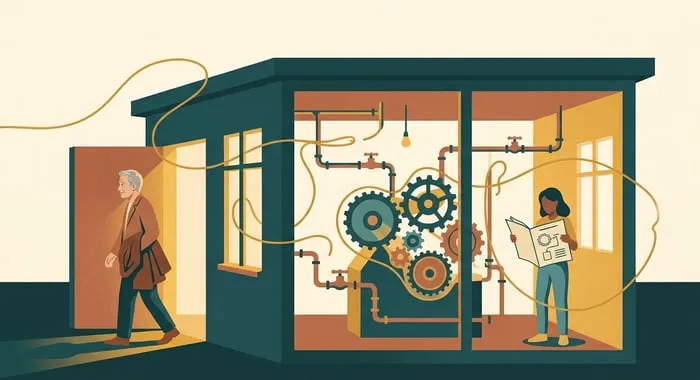 The goal isn’t a business that runs itself. It’s one that keeps running when you step away.
This is for founders and small business owners who are thinking beyond their own working years: people who want what they build to outlast their energy, and who’d rather see the awkward numbers now than discover them in year fifteen. It’s especially for people in high-inflation economies who’ve been told that a fixed deposit is a plan.
If you’re early, broke, or buried in debt, skip the generational part for now. Get your cash flow stable first. And if you’re hoping this article will hand you a stream of effortless income, it won’t. I don’t think one exists.
The honest version of passive income is a trade: you work hard early so that your hours matter less later, you give up some control to get some freedom, and you accept that nothing runs itself. What you can build, if you’re careful, is something that keeps going when you step back, and that’s worth far more than the word “passive” promises.
Related posts
-
Business · Startups
Alikolo Raised $100,000 and Couldn't Answer One Question.
-
Business · Management
Secure Payment Gateway Checklist for Merchants