
Binance Hack: How a DevOps Laptop Led to $6.3B Stolen
Binance lost about $6.3B in October 2026 with no leaked private key. How a DevOps laptop became the way in, and the controls that limit your own signing path.

Binance lost about $6.3 billion from its hot wallets on 29 October 2026, and no wallet private key was reported stolen. Binance’s early findings say the way in was a compromised DevOps engineer’s laptop, which gave an attacker access to a service container that could submit withdrawals; the investigation later found more points of breach. The FBI attributes the theft to North Korea’s TraderTraitor group. The lesson for DevOps teams is that the weak point was the trust between ordinary infrastructure and the signer, not the cryptography.
The biggest crypto heist in history, as far as anyone has told us so far, started on a laptop.
Not a zero-day in Ethereum. Not a broken signature scheme. Not some exotic attack on the math. Binance’s own first statement said a compromised DevOps engineer’s laptop gave an attacker a way into a service container, and that container could submit withdrawals. Then the money left.
I’m a DevOps person. When I read that sentence on 30 October, I didn’t think “crypto problem.” I thought about every laptop I’ve ever had with a kubeconfig on it.
This isn’t a post about crypto prices or who gets blamed. It’s about the boring part: how a chain of ordinary infrastructure trust turned into $6.3 billion in outflows, and what you can change this week so your own version of that chain is shorter and louder. The investigation is still going, so I’ll be careful to separate what’s confirmed from what I’m inferring.
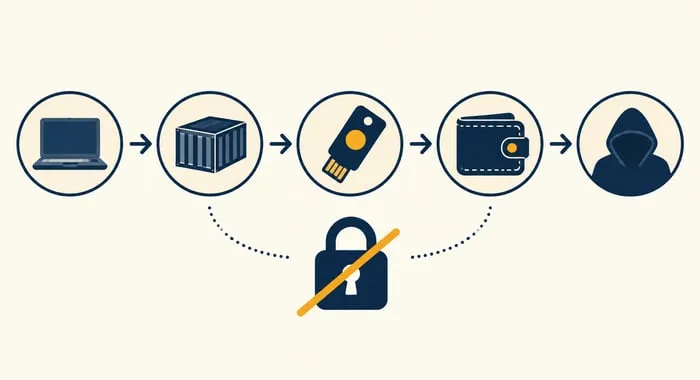 Figure 1: Five hops, zero broken cryptography. Sources: Binance, TRM Labs, Elliptic.
Binance says its hot wallets were compromised around 20:05 UTC on 29 October 2026, with losses of about 6.3 USD billion in token assets, according to its second incident update. Analytics firms put the number a little higher. TRM Labs counts 6.43 billion, so treat “$6.3–6.4B” as the honest range.
The first Binance statement, published on 30 October 2026, said the incident may involve a compromised DevOps engineer’s laptop, which let an attacker reach a service container and submit unauthorized withdrawal transactions. It also said there was no evidence any wallet private key leaked. About a day later the second update walked part of that back: the laptop was one point of breach, but the investigation had found more.
That “no key leaked” line is the most important sentence in the whole story, and also the most misread. If no key leaked, how did valid signatures appear on transactions nobody authorized? Because the attacker didn’t need the key. They needed the thing that holds the key to sign for them.
The on-chain side has been reconstructed in unusual detail. According to Elliptic’s write-up, the attacker prepared for a couple of days. Three tiny withdrawals from Tornado Cash funded a fresh operator wallet on 28 and 29 October. A malicious “sweeper” contract was deployed at 15:59 UTC on 29 October, about four hours before the first outflow, and Elliptic says it was rehearsed on another wallet first.
Then came the part that makes Ethereum developers wince. At 20:20 UTC, the attacker submitted a single transaction carrying 50 EIP-7702 authorizations, every one validly signed by a Binance hot wallet that Elliptic labels “Binance 14.” EIP-7702, which shipped with the Pectra upgrade in May 2025, lets a normal wallet delegate its behavior to a smart contract by signing an authorization. Once Binance 14 had signed authorizations pointing at the attacker’s contract, the contract could do whatever the attacker told it to. About three and a half minutes later it emptied the wallet of 167,464 ETH and 63 other tokens, including 1.6 billion USDT.
The delegation stayed in place afterward. Elliptic reports the attacker kept sweeping new deposits into the wallet over the next hours, the last at 23:56 UTC, and used the wallet’s owner rights over a second Binance wallet to pull another 823 million USDC. TRM Labs lists the same follow-up sweeps. Bitquery’s count, relayed by Euronews, is that Binance’s own withdrawal system signed funds out of 17 hot wallets across just under four hours.
The other chains looked different. TRM says on the other nine chains the transfers were ordinary signed transactions, and it reads that as a sign the compromise was in Binance’s hot-wallet signing infrastructure, not a flaw in Ethereum itself. The 7702 trick was the attacker’s way of getting more mileage on one chain. The real breach was upstream. TRM says 10 chains total, Elliptic says 11. Pick one after the post-mortem.
Binance’s co-CEO Richard Teng reportedly said the delegation did not pass through the exchange’s normal approval controls. Read that twice. Whatever those approval controls were, the attacker found a path that went around them.
On attribution, the FBI said on Saturday 31 October 2026 that North Korea was responsible and named the TraderTraitor group, the same group blamed for the roughly $1.5 billion Bybit theft in February 2025, per reporting from RTÉ. Not everyone is lining up behind that. NZ Herald notes that President Trump cast doubt on North Korea’s involvement. I’m not going to referee that. The technical lessons don’t depend on who did it.
Picture how any serious custody system works. There’s a service that decides a withdrawal should happen. There’s a signer that holds key material, usually inside an HSM or an MPC cluster, and produces signatures. Between them is a trust relationship: the signer signs when the service asks.
The whole safety story rests on how much scrutiny the signer applies to the request. If the signer is a dumb oracle that signs whatever an authenticated internal service sends, then the real security boundary is “who can talk to that internal service.” And that boundary, in most companies, is a pile of IAM roles, network paths, Kubernetes permissions, and the people who hold them.
That’s why Binance’s description is so ordinary and so alarming. A laptop reaches a container. The container is allowed to ask for withdrawals. The signer obliges. No cryptography broken at any step, because every step was a legitimate request from a trusted caller. The attacker just became the trusted caller.
I want to be clear that this is my reading of the public facts, not Binance’s confirmed root cause. They promised a technical post-mortem once the facts are verified, and until it lands, the exact path from laptop to signer is unknown to everyone outside the company. What the public record does support is the shape: developer machine, internal service, signing path, no key theft.
If that shape sounds familiar, it should. The Bybit theft in February 2025, from the same group by the FBI’s account, was traced by investigators to a compromised developer machine at Safe{Wallet}, whose tampered front-end code then tricked Bybit’s signers. I’m recalling it from background knowledge, not from today’s research. Different victim, different mechanism, same family of failure: the attacker doesn’t fight the vault, they get close to the people and machines that open it.
I can’t tell you which specific control was missing at Binance. I can tell you which questions I’d ask about any system that matches the public description, because I’d ask them about mine.
The first is the one every incident review lands on eventually: why could a developer’s laptop reach production at all? Not “was the laptop patched.” Why was there a network path and a credential that let a compromised endpoint get to a service that can move money? Most of us have an answer shaped like “because debugging at 2 a.m. is painful without it.” That answer is precisely what attackers are shopping for.
The second is blast radius on the money side. Seventeen hot wallets, billions in a single wallet’s balance, a 1.6 billion USDT sweep in one call. A hot wallet is supposed to be a float that covers the next few hours of withdrawals, topped up from cold storage on a schedule. When one hot wallet holds enough to be a headline on its own, the float has quietly become a vault. I don’t know Binance’s internal treasury policy, and there are real liquidity reasons exchanges hold what they hold. But from the outside, the amount available to a single compromised path looks enormous.
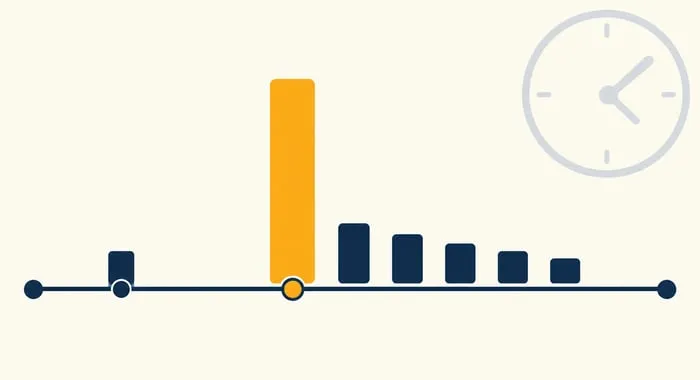 Figure 3: The first sweep took minutes. The follow-ups kept collecting for hours. Timeline per Elliptic and TRM Labs (UTC, Oct 29).
The third is that the signer apparently produced signatures that its approval controls never saw. Whatever sat in front of the signing path, the attacker found a request type or a route that skipped it. This is the failure I think about most. Policy that lives in the application layer, in the same container the attacker is now inside, isn’t policy. It’s a suggestion.
The fourth is time. By Elliptic’s and TRM’s timelines, the attacker held a delegated hot wallet for nearly four hours and swept it repeatedly. The big first sweep landed within minutes. But “we noticed and stopped it” apparently took a long while, and the follow-up sweeps kept collecting. Detection and a hard stop are two different engineering problems, and I’d guess most exchanges, and most of us, have only built the first.
Everything below is how I’d close the gap I just described. It isn’t a claim about what Binance did or didn’t have.
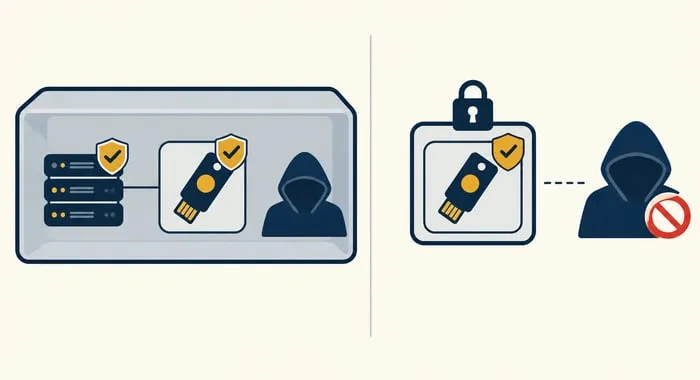 Figure 2: Policy next to the app is a suggestion. Policy inside the signing boundary is a rule.
The signer should evaluate every request against rules the caller cannot alter, and it should refuse anything that isn’t a structured, understood operation. Specifically it should never sign a raw digest on request, because a raw digest can be a transaction, an EIP-7702 authorization, a typed message, or anything else the attacker can dress up. Here’s the shape of that gate in TypeScript. It’s deliberately small, because the point is that it’s boring and lives where the key lives.
// Runs INSIDE the signing boundary (HSM host, MPC node, enclave).// Never in the same container or trust domain as the service that calls it.
type SignRequest =  | {      kind: "transfer";      chainId: number;      to: string;      asset: string;      amount: bigint;      withdrawalId: string;    }  | { kind: "raw_digest"; digest: string }  | { kind: "authorization_7702"; chainId: number; delegate: string };
type SignerState = {  allowedDestinations: Map<number, Set<string>>; // per chain, change-controlled  perTxMax: Map<string, bigint>;                 // per asset  windowMax: Map<string, bigint>;                // per asset, rolling 1h  spentInWindow: (asset: string) => bigint;  withdrawalIsApproved: (id: string) => boolean; // checked against an independent ledger};
export function authorize(req: SignRequest, s: SignerState): { ok: true } | { ok: false; why: string } {  // 1. Only structured transfers are signable. No raw digests, ever.  //    No delegation authorizations unless a separate, human-approved flow handles them.  if (req.kind !== "transfer") {    return { ok: false, why: `refusing ${req.kind}: not a transfer` };  }
  // 2. The withdrawal must exist in a ledger the caller can't write to.  if (!s.withdrawalIsApproved(req.withdrawalId)) {    return { ok: false, why: "no approved withdrawal record" };  }
  // 3. Destination allowlist for hot-wallet-to-hot-wallet moves.  const allowed = s.allowedDestinations.get(req.chainId);  const isInternal = allowed?.has(req.to.toLowerCase()) ?? false;
  // 4. Hard limits that don't care how convincing the caller is.  const perTx = s.perTxMax.get(req.asset);  if (perTx !== undefined && req.amount > perTx) {    return { ok: false, why: "over per-transaction limit" };  }  const window = s.windowMax.get(req.asset);  if (window !== undefined && s.spentInWindow(req.asset) + req.amount > window) {    return { ok: false, why: "rolling window exhausted: trip breaker, page a human" };  }
  return isInternal || req.amount < 10_000n * 10n ** 6n    ? { ok: true }    : { ok: false, why: "large external transfer needs out-of-band approval" };}
The last line is a placeholder for whatever your real threshold logic is. The structure matters more than the numbers. The signer decides, from its own state, and the caller can’t talk it into anything. And the “withdrawal exists in a ledger the caller can’t write to” check is the one that would have turned “attacker controls the orchestrating service” into “attacker controls a service that now has nothing to orchestrate.”
A network policy isn’t a substitute for the signer’s own checks, because if the attacker is the orchestrator, the orchestrator is the one allowed through. But it removes every other path, and it makes the “who can call this” list short enough to audit.
apiVersion: networking.k8s.io/v1kind: NetworkPolicymetadata: name: signer-default-deny namespace: custodyspec: podSelector: matchLabels: app: signer policyTypes: ["Ingress", "Egress"] ingress: - from: - podSelector: matchLabels: app: withdrawal-orchestrator ports: - protocol: TCP port: 8443 egress: # Only the HSM / KMS endpoint. Add the exact CIDR or use a CNI that supports FQDN rules. - to: - ipBlock: cidr: 10.20.30.40/32 ports: - protocol: TCP port: 443Pair this with workload identity, mutual TLS between orchestrator and signer, and admission control so nobody can kubectl exec into either pod from a laptop without a break-glass ticket. If your engineers can open a shell inside the thing that can talk to the signer, your signer’s security is your laptop’s security.
This is the unglamorous core of the whole post. A developer laptop is a browser, a chat client, a package manager, and a pile of tokens, all running on hardware that gets phished, tricked into installing “interview assignments,” and infected through dependencies. North Korean operators in particular are well documented for targeting developers with fake recruiter conversations and trojaned take-home tasks. I don’t know how this laptop was compromised, and I won’t pretend to, but that’s the threat class.
So the fix isn’t “tell engineers to be careful.” It’s to stop letting a single compromised laptop be enough. Production access should go through short-lived credentials issued just in time, with approval, bound to a managed and healthy device. Admin work on anything near money should happen from a hardened, separate admin workstation or a remote desktop that has nothing else on it. Standing kubeconfigs, long-lived cloud keys, and SSH agents that quietly forward to production should be treated as incident precursors. Use phishing-resistant MFA (FIDO2 hardware keys), and pay attention to session-token theft, because a stolen session cookie walks around MFA completely.
Here’s a nice concrete one for anyone holding EVM hot wallets. An address that should be a plain externally owned account has no contract code. Under EIP-7702, a delegated account has code that starts with 0xef0100 followed by the 20-byte delegate address. So for any address you own and don’t intend to delegate, “code is not empty” is a five-alarm event. A poller for that is about twenty lines.
// Alert if any hot wallet we own gains EIP-7702 delegation code.const RPC = process.env.ETH_RPC_URL!;const WATCHED = (process.env.HOT_WALLETS ?? "").split(",").filter(Boolean);
async function getCode(addr: string): Promise<string> {  const res = await fetch(RPC, {    method: "POST",    headers: { "content-type": "application/json" },    body: JSON.stringify({      jsonrpc: "2.0",      id: 1,      method: "eth_getCode",      params: [addr, "latest"],    }),  });  const json = (await res.json()) as { result: string };  return json.result;}
async function tick() {  for (const addr of WATCHED) {    const code = await getCode(addr);    if (code !== "0x") {      const delegated = code.toLowerCase().startsWith("0xef0100");      await page(`HOT WALLET ${addr} has code (${delegated ? "7702 delegation" : "contract"}): ${code}`);      await tripWithdrawalBreaker(addr); // stop signing for this wallet NOW    }  }}
setInterval(tick, 5_000);
Honest limit: this wouldn’t have saved the first big sweep, which landed minutes after the delegation. It would have caught the delegation within a block or so and given you a clean trigger to stop everything that followed. In this incident that includes the follow-up sweeps over the next few hours. A breaker you trip automatically beats a war room you assemble.
The best defense against “attacker fully controls the orchestrator” is that the orchestrator can only ever reach a small float. Keep hot balances sized to hours of expected withdrawals, refill from cold storage on a schedule with a human in the loop for anything large, and set rolling per-asset velocity limits inside the signer. When that limit trips, the system should stop and page someone, not log a warning and carry on. Users get annoyed when a big withdrawal is delayed. They get a lot more annoyed when the exchange is out $6 billion.
None of this is free, and none of it is a guarantee.
Hardening the signer costs you operationally. Tight policy means legitimate big moves need more steps, and during an outage that friction will make someone want to widen the rules. The most dangerous moment for any control like this is the week after an incident, when it gets loosened for a good reason and nobody tightens it again.
A well-resourced state group isn’t stopped by a checklist. The honest goal is to make the attack require more steps, make each step noisy, and cap the loss when a step succeeds. Bounding the damage is a realistic target. Total prevention isn’t.
The facts themselves are also still moving. Binance has said it will publish a full post-mortem, and I’d expect parts of the picture to change when it does. The “laptop first” narrative has already been qualified once, and the exact relationship between the laptop, the container, and the extra breach points isn’t public. The figures for stolen and frozen amounts differ between Binance, TRM, and Elliptic. Binance says roughly 2.84 billion, and TRM counts around $2.7 billion. I’d take all of it as provisional.
And I’m not an insider. Everything I’ve called a lesson comes from public reporting and my own experience running production systems. If Binance had half these controls and the attacker still got through, that’s a more depressing story and a more useful one. We’ll know when the post-mortem arrives.
For years, the standard answer to “how do we protect crypto custody” was “protect the keys.” HSMs, MPC, multi-sig, cold storage. Those defenses got good. The attackers adapted, and they now treat the key as the one thing they don’t need. Bybit in 2025 and Binance in 2026, both attributed to the same group, point the same direction: the weak point is the control plane around the key. The CI pipeline, the admin console, the developer endpoint, the service that’s allowed to ask.
That’s an industry problem, and it isn’t confined to crypto. Any company where a service account can trigger an irreversible action has the same shape. Payments, payroll, infrastructure teardown, production database deletes. If a compromised engineer laptop can lead to an irreversible action without a second, independent check, you’re running the same architecture. Crypto just makes the loss legible in dollars within hours.
There’s an uncomfortable side to the aftermath too. Binance could write a check for roughly $6.34 billion, replenish its SAFU emergency fund, and get withdrawals flowing again within days. Its recovery updates put coverage of stolen assets at about 95% by 1 November 2026. Almost no other company in the industry could absorb that. Which means “the platform will make you whole” is a property of exactly one or two firms, and for everyone else, preventing the loss is the only real option.
If you run platform, DevOps, or SRE for anything that can move money, sign things, or delete things you can’t get back, this is for you, and the checklist below is meant to be pasted into your next planning meeting. Same if you’re a founder wondering what your engineers’ laptops can actually reach.
If you’re here for price action, for a verdict on North Korean attribution, or for a ruling on whether you should trust any exchange with your savings, skip it. I’m not qualified to answer those, and the technical argument doesn’t depend on them.
Here’s the thought I keep returning to. Our industry spent a decade making keys hard to steal, and it worked so well that attackers stopped bothering. The next decade is about making the people and machines that are allowed to use the keys boring, minimal, and watched. Your most privileged secret may well be the laptop on your desk.
- List every service in your stack that can trigger an irreversible action (payments, deletes, key use). Draw the path from an engineer’s laptop to each one.
- Move policy for those actions into the signer or executor, outside the caller’s trust domain. Refuse raw or unstructured signing requests.
- Require an approval record the calling service cannot write to, checked at execution time.
- Add per-asset, per-transaction, and rolling-window limits that stop and page a human when hit.
- Shrink hot balances to hours of expected demand. Refill from cold storage on a schedule.
- Default-deny network access to the signer. Use mTLS and workload identity. Block
kubectl execfrom laptops outside break-glass. - Replace standing prod credentials with short-lived, approved, device-bound access. Use FIDO2 keys and watch for session-token theft.
- Do privileged work from a hardened admin workstation or remote desktop that runs nothing else.
- Alert on any code appearing at addresses you own that should be plain accounts (
eth_getCodenot0x), and auto-trip a withdrawal breaker. - Rehearse the stop button. Know who can pause withdrawals, how long it takes, and test it quarterly.
- Re-read Binance’s post-mortem when it’s published and diff it against this list.
Frequently asked questions
How did the Binance hack happen?
Binance's early investigation says a compromised DevOps engineer's laptop gave an attacker access to a service container that could submit unauthorized withdrawal transactions. Binance later said it found additional points of breach. Its full technical post-mortem had not been published when this was written.
Were Binance's private keys stolen?
Binance says it found no evidence of a wallet private key leak. Analysts such as TRM Labs read the valid signatures as a sign that Binance's hot-wallet signing infrastructure was compromised, so the attacker did not need the keys themselves.
How much was stolen from Binance and who did it?
Binance estimates about $6.3 billion, while TRM Labs counts $6.36 billion and Elliptic $6.43 billion. The FBI said on 31 October 2026 that North Korea was responsible and named the TraderTraitor group, though President Trump cast doubt on that attribution.
What is the EIP-7702 part of the Binance hack?
On Ethereum, the attacker submitted one transaction carrying 50 EIP-7702 authorizations signed by a Binance hot wallet, which delegated that wallet's behavior to an attacker-controlled sweeper contract. Analysts say this shows a compromise of Binance's signing path, not a flaw in Ethereum.
How can DevOps teams prevent a similar attack?
Enforce policy inside the signing boundary and refuse raw signing requests, keep hot balances small, default-deny network access to the signer, replace standing production credentials with short-lived device-bound access, and alert on unexpected code at addresses you own. These limit the damage but cannot guarantee prevention.
Related posts
-
Technology · Cyber Security
PHP2Shell Explained: The PHP RCE Bugs, the Patch and the Lessons
-
Technology · Cyber Security
Sock Puppet Accounts: What They Are and How to Spot Them
-
Technology · Engineering
GitHub + GitLab Dual Push: One Remote, Automatic Backup
-
Technology · Engineering
Git and GitHub Best Practices: A Complete Guide